
More items from this sellerView All

Description
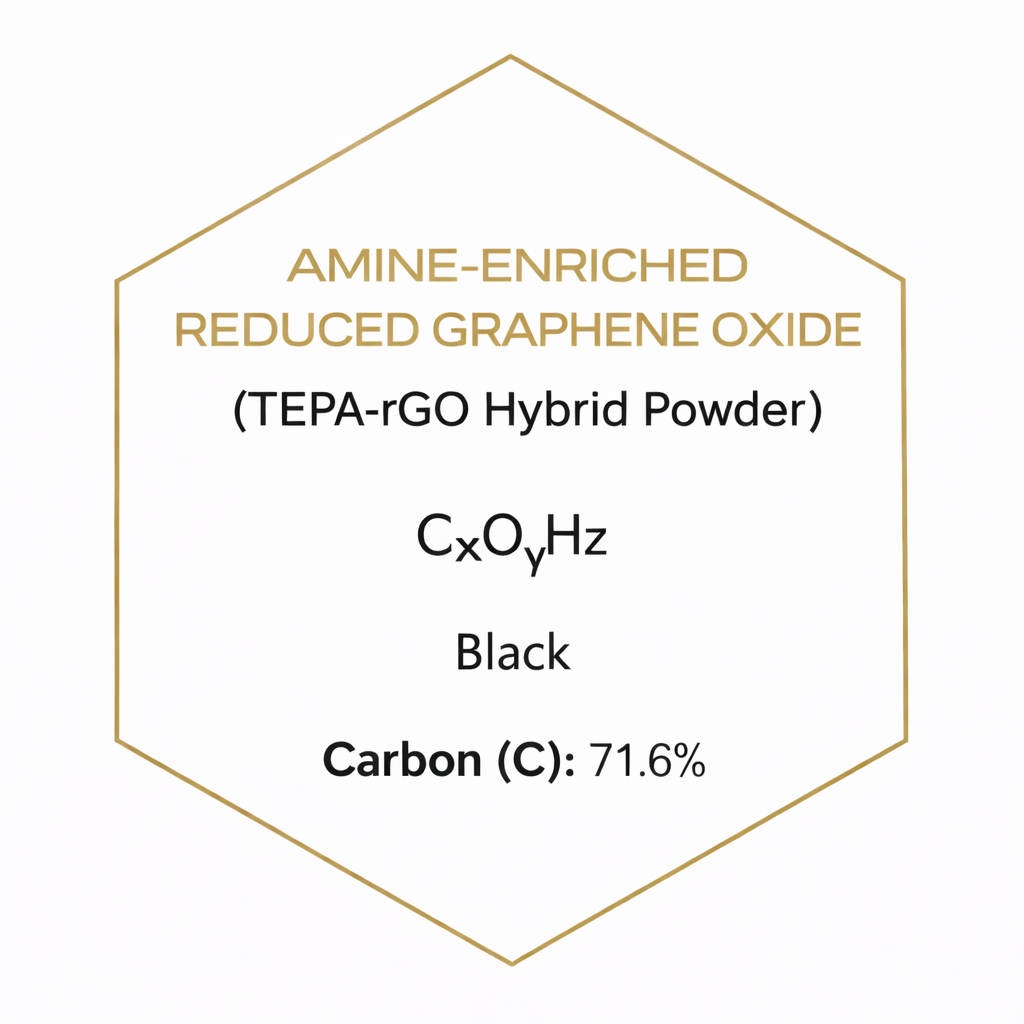
Amine-Enriched Reduced Graphene Oxide (TEPA-rGO Hybrid Powder)
Material Type: Functionalized Reduced Graphene Oxide
Form: Powder
Color: Black
Chemical Composition: Carbon-based graphene framework with amine functional groups
Linear Formula: CₓOᵧH𝓏
Elemental Composition (Atomic %)
Carbon (C): 71.6%
Nitrogen (N): 13.8%
Oxygen (O): 11.2%
Sodium (Na): 3.0%
Residual Carbon: 0.4%
Amine-Enriched Reduced Graphene Oxide (TEPA-rGO Hybrid Powder) is a chemically modified graphene-based nanomaterial designed to deliver enhanced surface activity, improved dispersibility, and strong interfacial interaction capabilities. The incorporation of multi-amine functional groups onto reduced graphene oxide sheets introduces highly reactive sites that enable effective chemical bonding with a wide range of matrices and substrates.
This functionalization strategy significantly improves compatibility in both aqueous and organic systems while preserving the intrinsic advantages of reduced graphene oxide, such as high surface area, electrical conductivity, and mechanical robustness. The presence of amine groups not only enhances dispersion stability but also allows tailored surface chemistry for advanced material design, making this product highly suitable for multifunctional composites, coatings, and electrochemical systems.
Applications
Composite Reinforcement
The amine-rich surface promotes strong interfacial adhesion with polymers, elastomers, and metal matrices. This leads to improved mechanical strength, enhanced load transfer, and increased electrical and thermal conductivity in composite systems.
Surface Functionalization and Adhesion Enhancement
Amine functionalities enable covalent or ionic interactions with resins, coatings, and substrates, improving bonding performance in adhesives, protective coatings, and engineered surfaces.
Dispersion and Stability Enhancement
Functional amine groups significantly improve compatibility in water-based systems, organic solvents, and polymer solutions, ensuring uniform dispersion in films, inks, and coating formulations.
Sensors and Bio-Functional Interfaces
The chemically active amine sites act as anchoring points for biomolecules, enzymes, and sensing elements, enabling use in chemical sensors, gas sensors, and biosensing platforms.
Energy Storage and Electrode Engineering
When incorporated into electrode materials, amine-functionalized rGO contributes to improved electrochemical durability, charge transport, and capacitance, supporting applications in batteries and supercapacitors.
Corrosion-Resistant Coatings
Graphene’s barrier effect combined with enhanced substrate adhesion improves corrosion protection on metal surfaces, especially in aggressive environments.
Catalysis and Catalyst Supports
Surface amine ligands facilitate the immobilization and stabilization of metal nanoparticles, making this material suitable as a robust support for heterogeneous catalytic systems.
Thermal Interface and Heat-Transfer Materials
Improves interfacial heat conduction within composite structures, supporting applications in thermal interface materials (TIMs), heat spreaders, and thermal management components.
Membranes and Separation Technologies
Amine functionality allows tuning of surface polarity and selectivity, enhancing filtration efficiency and separation performance in membrane-based systems.
FTIR Analysis

Raman Analysis

Additional information
| Gram | 1 g, 5 g, 25 g, 100 g, 500 g, 1000 g |
|---|