
More items from this sellerView All

Description
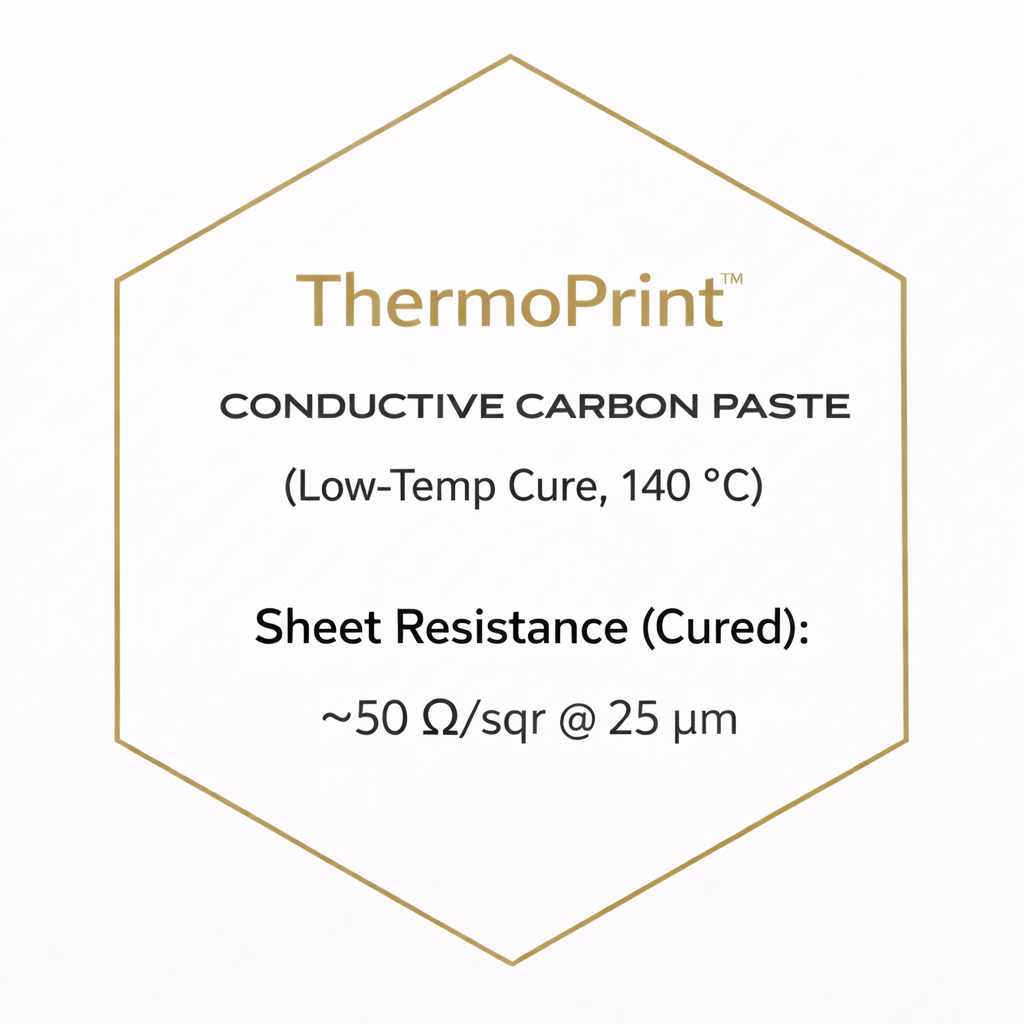
ThermoPrint™ Conductive Carbon Paste (Low-Temp Cure, 140 °C)
Material Type: Thermoplastic Conductive Carbon Paste
Curing Temperature: 140 °C
Recommended Curing Time: 30–60 minutes (convection oven)
Compatible Substrates: PET, Glass, FR-4
Electrical & Mechanical Properties
Sheet Resistance (Cured): ~50 Ω/sqr @ 25 µm
Viscosity (Uncured): 2.5 – 5 Pa·s @ 50 s⁻¹
Adhesion (Cross-Cut): 5B
Instrumented Hardness (HIT): ~120 MPa
Martens Hardness (HM): ~95 MPa
Printing Parameters
Screen Type: Stainless steel
Mesh: 325 DPI
Emulsion Thickness: ~13 µm
ThermoPrint™ Conductive Carbon Paste is a thermoplastic, screen-printable conductive material engineered for applications requiring low-temperature processing, reliable electrical performance, and strong substrate adhesion. The paste can be deposited as a single, continuous layer using standard screen-printing techniques, enabling efficient and repeatable pattern formation.
After curing at a relatively low temperature of 140 °C, the material develops a stable conductive network with consistent sheet resistance. Its thermoplastic nature provides mechanical robustness while maintaining flexibility, making it suitable for both rigid and polymer-based substrates. Optimized rheology ensures smooth printing behavior, dimensional accuracy, and uniform film thickness across printed features.
Applications
Printed and Flexible Electronics
ThermoPrint™ carbon paste is widely used to create conductive tracks and electrodes on polymer and composite substrates. Its low curing temperature supports flexible electronics and hybrid circuits without damaging heat-sensitive materials.
Sensor and Biosensor Platforms
The paste functions effectively as a conductive layer in electrochemical, chemical, and biological sensors. Its stable conductivity and surface compatibility contribute to reliable signal transfer and responsive sensing interfaces.
Photovoltaic and Thin-Film Devices
Suitable for use as a printable electrode in organic and thin-film photovoltaic technologies, enabling low-temperature processing while maintaining electrical continuity.
Membrane Switches and Keyboards
Provides durable and repeatable conductive contact layers in membrane keyboards and pressure-activated interfaces, benefiting from strong adhesion and thermoplastic resilience.
Energy Storage Components
Used as a conductive element in battery and supercapacitor electrodes, where it supports efficient charge transport and contributes to long-term cycling stability.
Automotive and Industrial Electronics
Applied in printed sensor circuits, control modules, and electronic components that require thermal stability and compatibility with automotive-grade substrates.
Additional information
| Gram | 100 g, 500 g, 1000 g, 5000 g |
|---|